
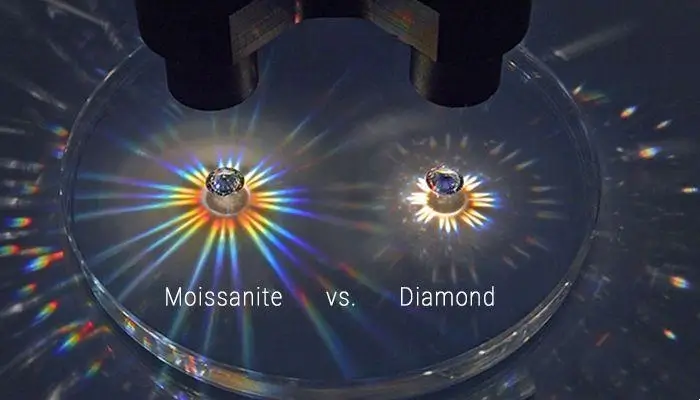
For centuries, diamond has been the undisputed benchmark for brilliance. But in the world of gemology, a new champion of light has emerged, not from deep within the earth, but from the stars and sophisticated labs. The question we often hear is: “Is moissanite really as sparkly as a diamond?” The short answer is a resounding yes—and the scientific data reveals that in key areas, it doesn’t just match diamond; it surpasses it. This isn’t about imitation; it’s about superior optical performance.
Let’s move beyond subjective opinion and look at the cold, hard facts that define a gemstone’s fire and brilliance.
The Metrics of Light: Refractive Index & Dispersion
Two key scientific properties determine how a gemstone interacts with light:
- Refractive Index (RI): This measures how much a gemstone bends or slows down light. A higher RI means more light is bent back to your eye (brilliance) rather than passing through the stone.
- Dispersion: This measures a gemstone’s ability to split white light into the spectral colors of the rainbow—what we see as fire.
Here is the definitive comparison:
| Optical Property | Moissanite | Diamond |
|---|---|---|
| Refractive Index | 2.65 – 2.69 | 2.42 |
| Dispersion | 0.104 | 0.044 |
What This Means for Your Eyes:
- Unmatched Fire: With a dispersion value more than twice that of diamond, moissanite exhibits exceptionally vibrant flashes of rainbow color. In well-cut stones, this results in a dazzling, lively display that is particularly noticeable in sunlight or under bright lighting.
- Intense Brilliance: The higher refractive index means moissanite can exhibit a different kind of brilliance—sometimes described as more “fiery” or “electric” compared to the classic white sparkle of a diamond. It returns a tremendous amount of light to the viewer.
A Visual Comparison: Imagine a diamond’s sparkle as a precise, white strobe light. Moissanite’s sparkle is that same intense light, but with a spectacular prismatic halo of color surrounding it. It’s not “better” in a subjective sense, but it is more. For those who love maximum visual impact and rainbow flashes, moissanite is the clear leader.
Addressing the “But…” – Color and Perception
A common follow-up question is about color. It’s true that some moissanite can display subtle warmth or a yellow/green tint in certain lights, especially in larger sizes or older cuts. This is not a lack of sparkle—it’s a different body color.
Modern cutting techniques and high-quality rough material have revolutionized this. The finest moissanite today is cut in “Colorless” (D-E-F range) grades that face up with no visible body color to the naked eye, allowing its superior fire and brilliance to take center stage without distraction.
The Durability of that Sparkle
A gem’s sparkle is only as good as its ability to maintain a clean surface. Moissanite ranks at 9.25 on the Mohs scale of hardness, making it the second-hardest gemstone used in jewelry. This exceptional hardness means it is highly resistant to scratches and abrasions that could cloud its surface over decades of wear. Its sparkle is not a temporary trait; it’s a permanent, built-in property guaranteed for a lifetime.
Conclusion: Not a Substitute, but a Superior Choice for Sparkle
The Moissanite vs. Diamond debate on brilliance isn’t a debate at all when you look at the numbers. Moissanite possesses a unique optical character defined by extraordinary fire and intense brilliance.
Choosing moissanite isn’t about settling for a “look-alike.” It’s about consciously choosing a gemstone that offers a more vibrant, colorful, and dramatic light performance, all while being ethically created and remarkably affordable. It’s for the individual who doesn’t just want a stone that sparkles, but one that performs.
Ready to see the difference for yourself? Explore our collection, where every piece showcases this legendary fire. Watch our 360° videos to see the rainbow flash in action, and discover why so many are choosing brilliance, redefined.
Explore our curated collection of precision-cut moissanite jewelry and witness the data come to life.